
Innovation Workshop: How to Run One That Actually Changes Behaviour
A good innovation workshop doesn't teach people to be creative - it stages the conditions where real problem-solving behaviour becomes visible, then holds up a mirror so it sticks. Most workshops skip that second half, which is why they generate energy on Friday and change nothing on Monday.
If you're shopping for an innovation workshop, this is what to look for, what to avoid, and why the format matters more than the topic.
Key takeaways
| Question | Short answer |
|---|---|
| What is an innovation workshop? | A structured session to build a team's problem-solving and idea-execution behaviour - ideally through practice, not lecture. |
| Why do most fail? | They reward brainstorming performance, produce sticky notes, and never change behaviour. |
| What makes a good one? | Real stakes, incomplete information, and a debrief that connects the experience to real work. |
| Best format? | A serious game beats slides - it makes actual behaviour visible and coachable. |
| Who should run it? | Someone who designs AND facilitates, so they can read the room and debrief live. |
What an innovation workshop is (and what it's not)
An innovation workshop is a session designed to improve how a team finds, frames, and solves problems - and turns ideas into action. That's the promise.
What it usually is: a facilitator, a slide deck about design thinking, a timed brainstorm, and a photo of a whiteboard covered in Post-its that nobody opens again.
Those are not the same thing. The first changes how people behave. The second changes how the afternoon felt.
Why most innovation workshops fail
Because a brainstorm rewards the wrong things. It rewards the loud, the confident, and the already-senior. It looks productive - lots of ideas, lots of energy - but it's mostly performance. People say what sounds smart, not what's true, because nothing is at stake.
And you can't develop a behaviour you can't see. A whiteboard hides the exact things you're trying to build: how someone frames a messy problem, whether they listen to the quiet person with the actual answer, what they do when the obvious move fails.
I once watched a room of genuinely brilliant people spend an hour "innovating" and produce forty ideas, and I could already tell which thirty-nine were going to die in the deck. The one that mattered came from the person who'd barely spoken - and it almost got missed because everyone was busy being impressive.
What a good innovation workshop actually does
1. Real stakes, not hypotheticals
People behave differently when a choice has a consequence, even a playful one. Stakes strip away the performance and show you how someone actually thinks under pressure.
2. Incomplete information, on purpose
Real innovation rarely fails for lack of ideas. It fails because the information is split - across functions, across seniority, across the people who talk in meetings and the people who don't - and nobody combines it. A good workshop reproduces that on purpose, so the team has to practise pulling the pieces together.
3. A debrief that reaches Monday
This is the half everyone skips. The activity creates the memory; the debrief turns it into a behaviour. Without a structured debrief connecting what just happened to real work, you've run an icebreaker, not a workshop.
Run it as a game, not a lecture
The fastest way to make problem-solving behaviour visible is a serious game - a designed environment with real stakes and consequences that respond to people's choices. Not gamification (points bolted onto a course). An actual game.
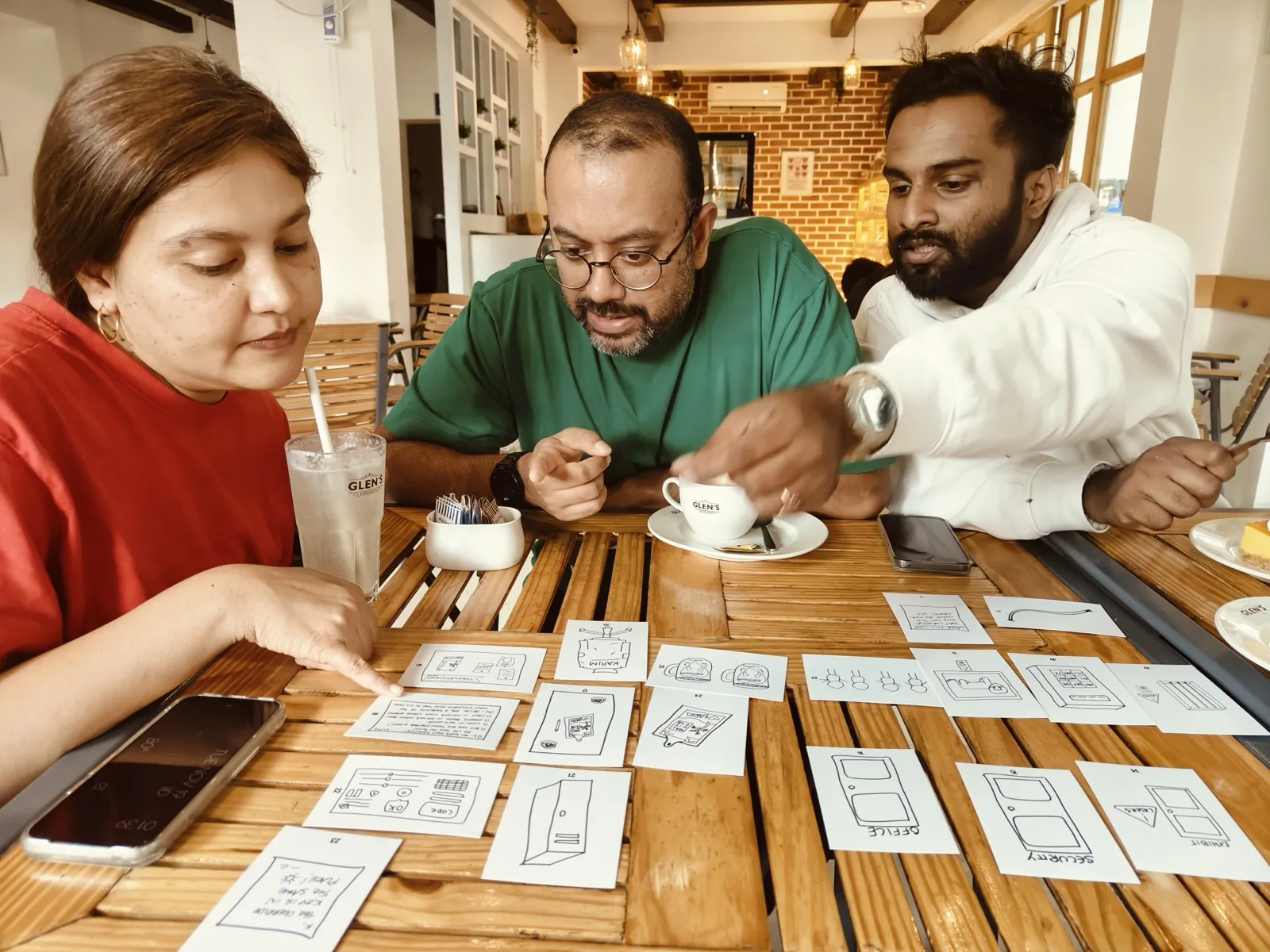
One I run for this is Sticky Fingers: an escape room in a deck of cards, where the clues are pictures split across the whole team and no one can see everything. To win, people have to listen, combine what they each hold, and separate signal from noise - under a clock. It scales from a group of 20-40 up to the largest run so far - 150 people, with two additional facilitators. And the behaviour it surfaces is the same behaviour that makes or breaks innovation at work.
The debrief then does the real work: where at your job are you sitting on a card someone else needs? Whose card have you not asked for?
How to choose an innovation workshop (5 questions to ask a vendor)
- Does the person designing it also run it? If design and delivery are split, nobody can read the room and adapt the debrief live.
- What's the ratio of practice to lecture? You want participants doing most of the work, not watching slides.
- What happens in the debrief? If they can't describe how the session connects to Monday, it won't.
- Is it a game or is it gamification? Real stakes and consequences, or points and badges on a talk? These are not the same.
- What behaviour will I be able to see afterwards? A good answer names specific behaviours. A weak one says "increased engagement."
If you want the long version of this, here's my full guide on how to choose a serious games vendor.
Run it as a full programme
If you want this as a packaged, outcome-led engagement rather than a one-off session, it lives inside Practical Innovation - a program built to turn problem-solving from a slogan into a repeatable team behaviour.
Frequently asked questions
How long should an innovation workshop be?
Long enough to play, fail, and debrief - a rushed 60-minute slot rarely gets past the activity into the learning. We run these as either a half-day or a full-day session; half a day is the sensible floor for a game-based workshop.
In-person or remote?
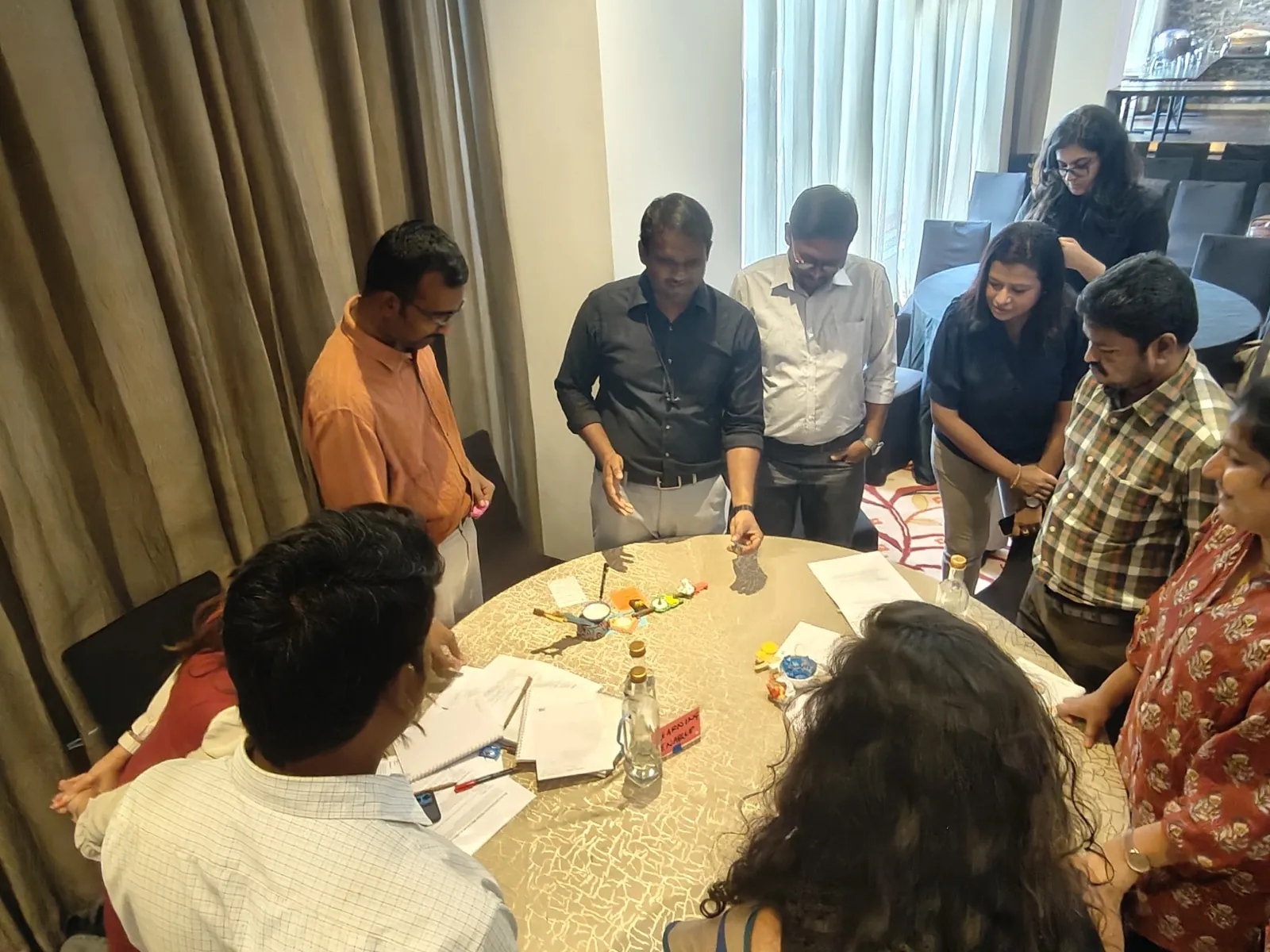
Both - we run this workshop in person and remotely. In-person tends to surface team behaviour more richly because you can read the room, but the remote format works well too. Typical group size is 20-40 people, and we have run it for as many as 150 with additional facilitators.
Is this the same as a design thinking workshop?
Overlapping but not identical. Design thinking is one framework; running innovation as a game is about building the underlying behaviour, whatever framework sits on top.
How is this different from a team-building activity?
A team-building activity aims for bonding. An innovation workshop aims for a specific, coachable behaviour change - the game is the method, not the point.
Run an innovation workshop with your team
I design these games and I run every one of them myself - because the value isn't the game, it's reading the room live and running the debrief that connects it to your real work. If you want an innovation workshop that changes what people do on Monday, let's talk.
Book a discovery call WhatsApp Arvindh