
The Philosophy Behind the Work
"Behaviour under pressure is the only data worth developing from, and you can only get that data by creating the pressure."
The Knowing–Doing Gap
Leaders typically understand good leadership conceptually. They can describe what good decision-making looks like, what effective collaboration requires, how to handle ambiguity. And yet under stress, in real situations with real stakes, they revert to less effective patterns.
The issue isn't knowledge. More information won't solve it. What's needed is practice in conditions that are close enough to reality to generate authentic behaviour.
Why Games Work
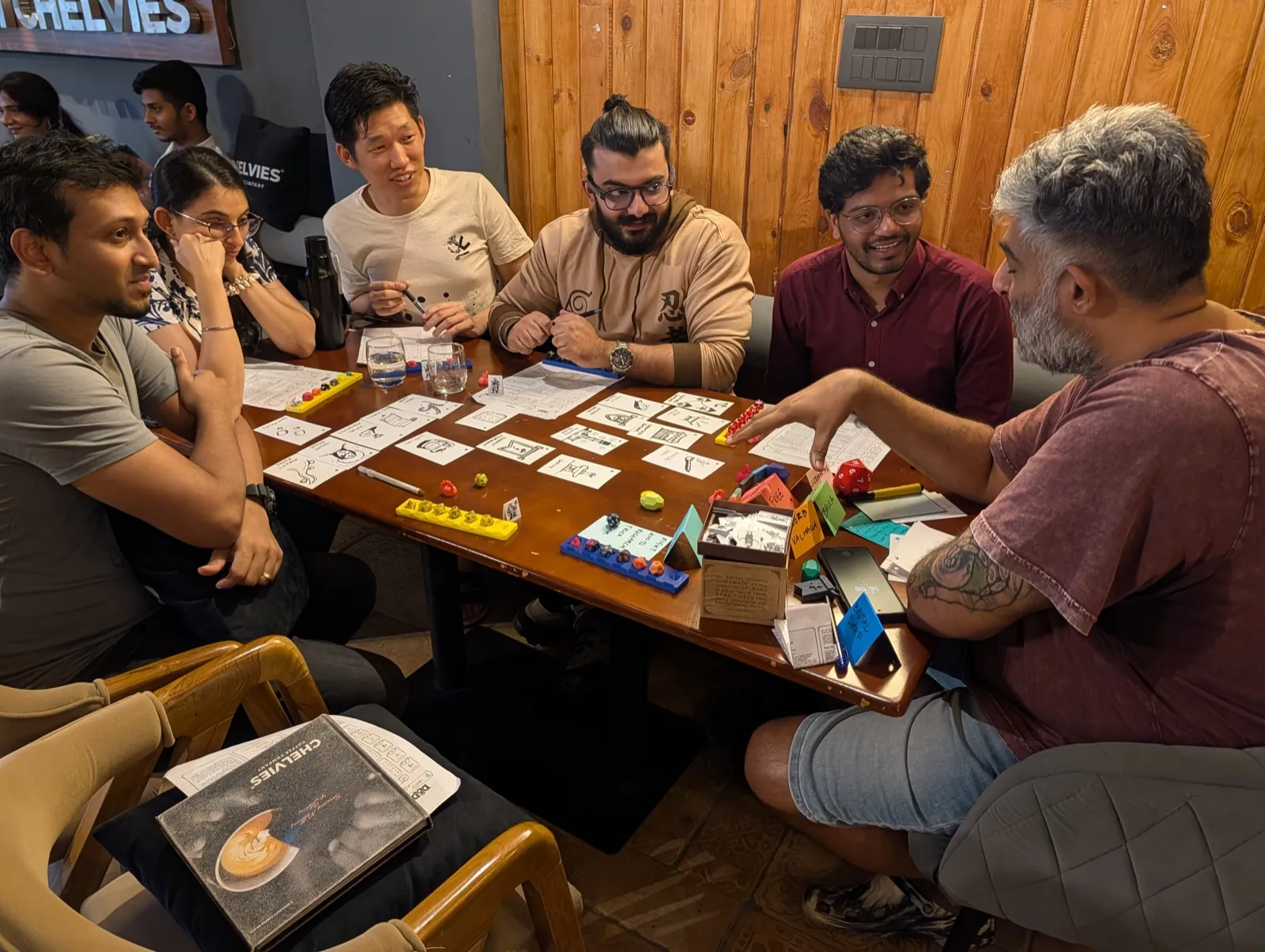
Games create a bounded reality where authentic behaviour emerges, because the emotional stakes are real, even if the scenario isn't. When something matters to a player inside the game, the way they respond mirrors the way they'd respond outside it.
This visibility makes behaviour observable, discussable, and ultimately developable. You can't coach someone on a pattern they haven't seen in themselves. The game creates the conditions for that seeing.
The EPPA Debrief Loop
Every session uses a four-stage facilitation method that converts game data into developmental insight:
- Experience. Reconstruct what actually happened. Not what people intended, but what occurred.
- Patterns. Identify the behavioural tendencies the game revealed. What kept showing up?
- Principles. Connect those patterns to leadership theory, through the participants' own insight, not the facilitator's lecture.
- Application. Generate concrete commitments for Monday morning, not general intentions.
How This Works in Practice
All sessions are facilitated personally by Arvindh Sundar. The organisation deliberately avoids licensing or training others, because the quality of the debrief depends on the designer running it. Clients manage their own relationships; the facilitator manages debrief quality.

What the Research Says
Edgar Dale's research on retention has been widely cited and sometimes over-simplified, but the underlying principle holds: people retain more from doing than from watching or reading. Experiential learning isn't a pedagogical preference, it's how human memory works. An experience that produces genuine emotion, genuine decision-making pressure, and genuine consequences creates stronger encoding than content delivered passively.
Richard Feynman's observation about the difference between knowing a thing's name and understanding it maps directly to the training problem. Leaders can name good behaviours readily. They can articulate the right answer in a case study discussion without any difficulty. But in the room, under pressure, those named principles don't fire reliably, because knowing a concept and having internalised it as a behavioural response are genuinely different cognitive states. Games create the conditions to move from the former to the latter.
The Designer-Facilitator Difference
Most facilitated experiences rely on a licensed facilitator running someone else's design. This creates a structural problem: the facilitator didn't design the mechanics, so they don't know what the mechanics were built to reveal. They can follow the debrief script, but they can't adapt it in real time to what actually happened in the room. If the group played unusually, if the expected pattern didn't emerge, or if a surprising one did, the facilitator has limited ability to pivot.
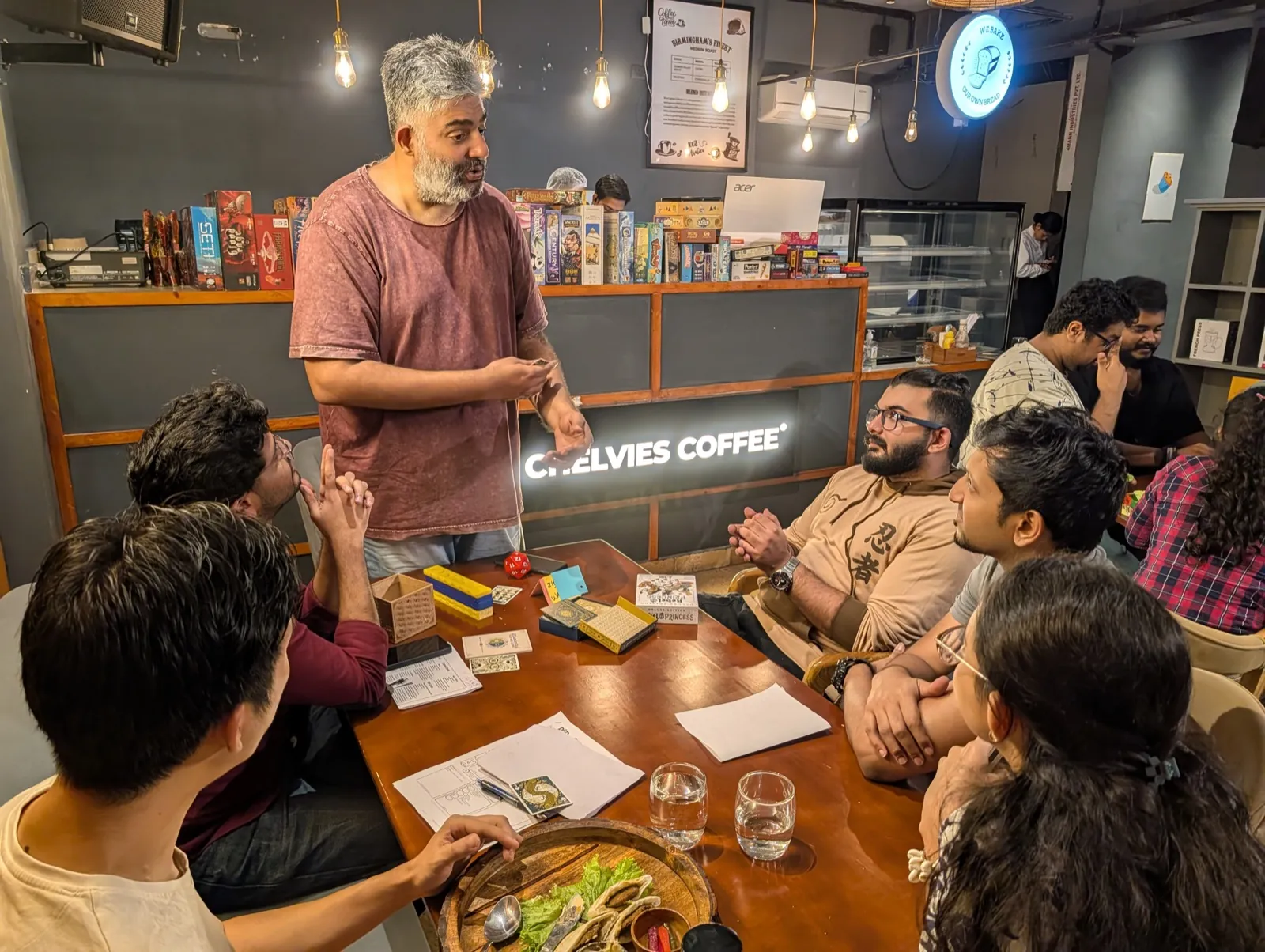
When the designer runs the session, the debrief is built from direct observation of what actually happened, not from a script written in advance. The quality of insight that comes from "I watched you make that decision in round three, and here is what I saw" is fundamentally different from "people typically find that…"
This is why Put The Player First runs as a solo practice. Every session is facilitated by Arvindh Sundar, the person who designed the mechanics. Scaling through licensing or associate delivery would require giving up the one thing that makes the debrief worth having.
Why In-Person Only
The social dynamics that games produce, the negotiation behaviour, the trust decisions, the coalition-building, the competitive pressure, require physical proximity. People read posture, facial expressions, and spatial behaviour constantly in a game. A player who moves across the room to approach a rival group makes a visible choice. Online, that move becomes invisible.
The debrief quality also degrades significantly online. Reconstructing what happened requires collective memory of shared experience. That memory is stronger when participants were physically present together, when they can point at each other, stand up to demonstrate what they did, and reference moments that the whole room witnessed. On a video call, those anchors disappear.
The decision to stay in-person only is not a technology preference. It's a quality standard. The game works because the behavioural data it produces is real. That data requires presence.
Common Questions
Can the game be run as part of a longer programme?
Yes. Games work well as standalone sessions and as anchors within longer development programmes. When used within a programme, the game typically runs on day one, generating behavioural data that the rest of the programme builds on, rather than being treated as an energiser or closing activity.
What if participants don't take the game seriously?
It doesn't happen in practice. Games activate genuine competitive and social instincts very quickly. Within 10-15 minutes, the room is behaving authentically, sometimes more authentically than in actual work situations, because the game removes the political consequences of real decisions while keeping the emotional ones.
How does this fit with psychometric tools like MBTI or DiSC?
Psychometric tools measure how people describe themselves. Games measure how people actually behave under pressure. The two produce different data that are both useful. Most participants find their game behaviour aligns with their psychometric profile but also reveals nuances that the profile misses, particularly around how they respond when under time pressure or when something valuable is at stake.
Is there evidence that serious games produce lasting behaviour change?
The honest answer is that all leadership development struggles to demonstrate lasting change, and serious games are no different in that respect. What games do demonstrably produce is stronger immediate insight, participants leave with more specific awareness of their patterns than they get from most other formats. Whether that insight translates to lasting change depends on what happens after the session: whether commitments are followed up, whether managers reinforce, whether the environment supports the new behaviour. Games give people better data to work from. The change still requires effort.