
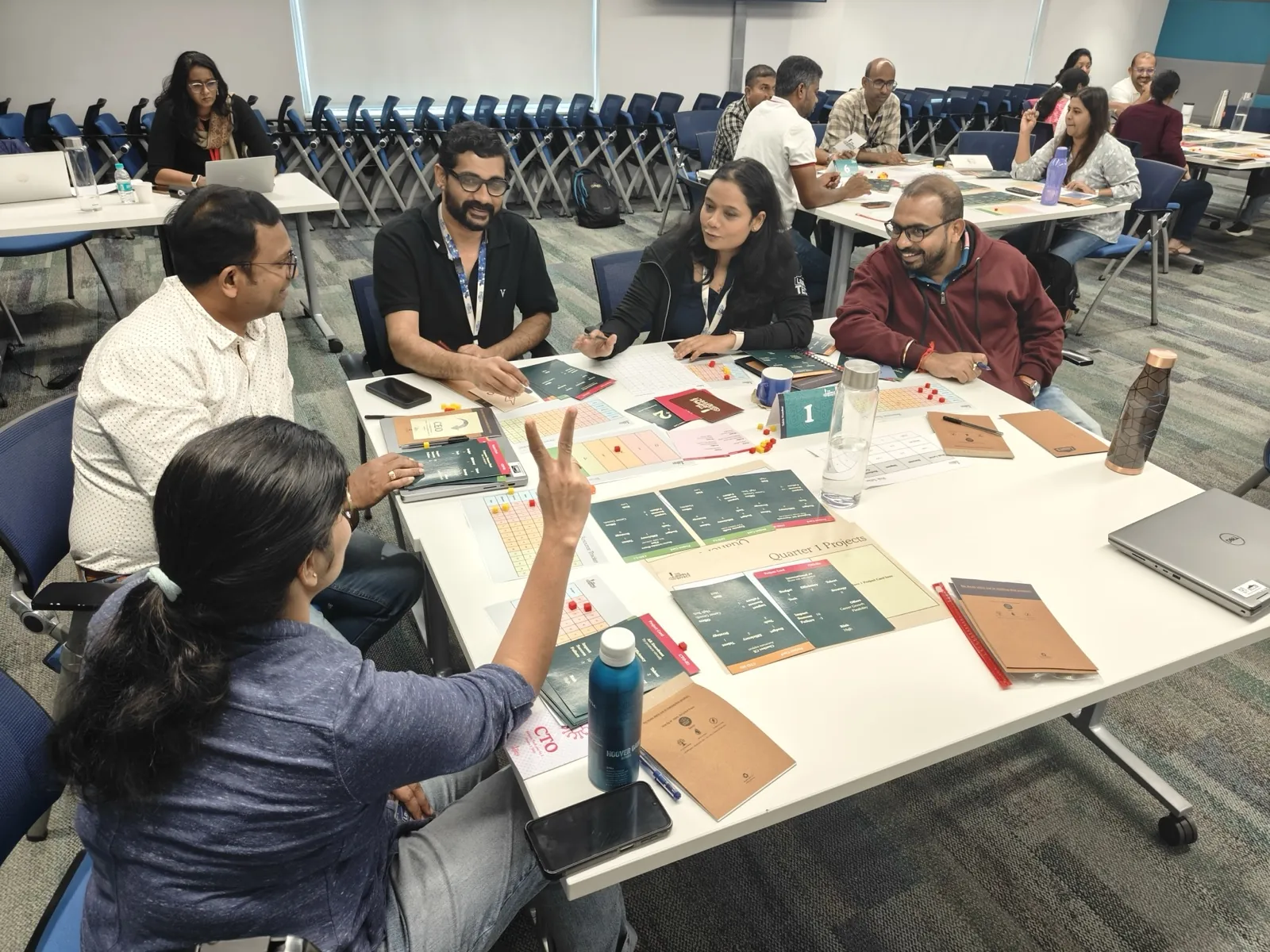
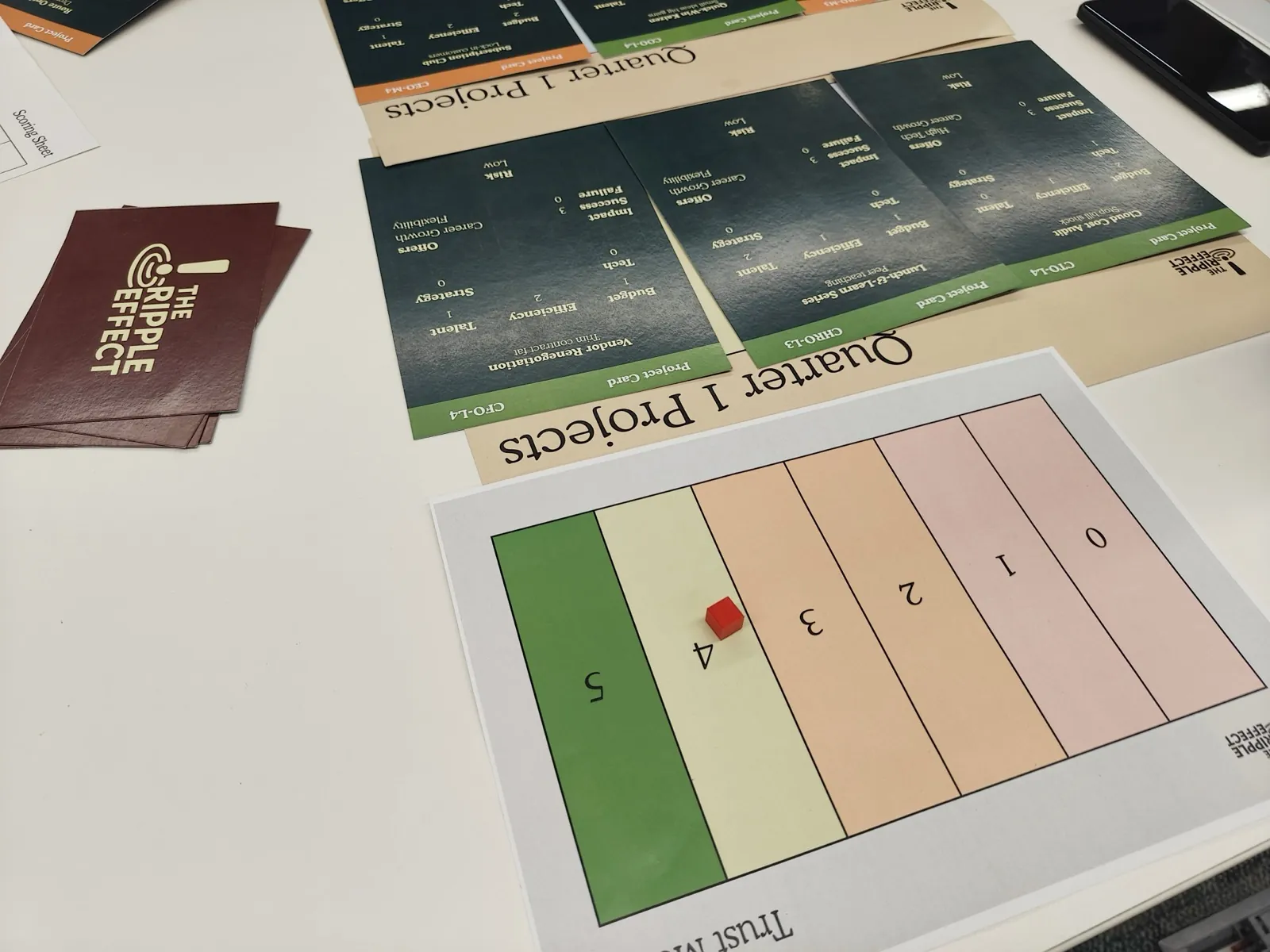
Ripple Effect sits inside one fictional company, Ripple Water Retail. Five players take the five CXO seats - CEO, CHRO, CTO, CMO and CFO - and each starts with a different resource. Every quarter they bid on a finite set of projects, so not everything can run. And here's the sting: every leader can hit their own targets and still watch the company lose, because five locally perfect decisions add up to a worse outcome for the whole.

 How It Works
Each player runs one function and controls one type of resource. Only some of the quarter's projects can be funded, so the CXOs have to negotiate, trade and make real trade-offs across the leadership table. The whole lesson is local maxima versus global maxima: the game is only winnable when leaders put the company's overall success ahead of their own function's scorecard. Larger groups run several tables of five in parallel.
What Happens in the Room
The leadership team starts confident. Everyone has a resource, a brief and clear targets - for the first 20 minutes it feels manageable. Then the wall hits. The maths stops working. No single function can fund what's in front of it alone. That's the exact moment the real game begins.
Someone makes the first move across the table, and that first approach sets the tone for the whole room. Come with an open offer and others follow. Come to extract information without giving anything back, and the other CXOs notice and close down. By the midpoint, every leader has a read on every other - who can be trusted, who's been evasive, who agreed to something and never delivered.
Late in the game, alliances get tested. Resource pressure climbs and partnerships that felt solid start to bend. Some hold. Some don't. I'm watching who breaks agreements quietly and who does it in the open - and whether the room catches it in real time.
 What it reveals about your leaders
The game exposes how each leader handles the tension between their own function's win and the company's win:
- Who reaches across the table first - and whether they frame it as an offer or a request. The ones who wait to be approached rarely land the best deals.
- The win-lose negotiator who squeezes maximum advantage from every trade, then can't understand why nobody wants to deal with them by round 3.
- Who weaponises information versus who shares it. The functions that drip-feed data to protect an edge, next to the ones that share openly and build trust twice as fast.
- The leader who defaults to "let me fix my own function first" while the other CXOs are already trading and pulling the company ahead without them.
- Who treats their peers as competitors instead of partners - even when the company only wins if they cooperate. This is the exact pattern that plays out between real functions.
- Who adapts when an alliance breaks - and who gets stuck relitigating the betrayal instead of finding the next path.
Who It's For
Organisations where cross-functional collaboration is genuinely hard. It works especially well for:
- Leadership teams drawn from different functions
- Enterprise leadership programmes
- Groups you need to pull out of silos
It hits hardest when you pair it with your own data on where collaboration keeps breaking down.
Specific Patterns That Surface
- The leader who perfects a plan for their own function while everyone else is already negotiating - and arrives at the table late and weaker for it
- The negotiator whose language says win-win but whose terms say win-lose - visible only in hindsight
- The CXO who controls every outbound message from their function - an information bottleneck that slows the whole leadership team
- The leader who treats other functions as rivals even when the company only wins if they cooperate - and pays for it in the final round
- The one who reaches across the table first and reframes the entire room's strategy inside 20 minutes
When to Bring This In
- Post-merger or acquisition, when combined teams are integrated on paper but haven't built working trust yet - especially if they used to compete for the same resources or customers
- Breaking silos between functions that are meant to be interdependent but run independently - sales and delivery, product and engineering, operations and commercial
- Large leadership cohorts from different business units who need a shared operating model and will genuinely work together once the programme ends
- Organisations where collaboration is the stated value but the incentives reward individual numbers - the game makes that contradiction visible without anyone having to say it out loud
Where the real learning lands: the debrief
Every session ends on an EPPA debrief - Experience, Patterns, Principles, Application. Nobody leaves with vague reflections. They leave with one named behaviour to change and one specific situation to use it in. And I run the debrief myself, as the person who watched every deal and every broken alliance - that continuity is what makes it stick.
Bring this to your team
Tell me where collaboration keeps breaking down across your functions, and I'll tell you honestly whether Ripple Effect is the right fit. No hard sell either way.
What Clients Say
"We'd run leadership workshops before. This was the first time we could actually see how our managers made decisions under pressure. The debrief alone was worth the session."
L&D Head, GCC (India)
"What surprised me was how quickly the room opened up. Within 20 minutes, patterns were visible that hadn't surfaced in six months of 360 feedback. We brought Arvindh back for two more cohorts."
Learning & Development Manager, Manufacturing
"I've sat through a lot of training. This was the first time I left thinking about my own behaviour, not the content on the slides."
Participant, Leadership Development Programme
Let's see if it fits your team
Book a quick discovery call and we'll talk through your team, your goals, and whether this is the right game - no obligation. Prefer to look first? I'll send the facilitation playbooks to your inbox so you can see exactly how it runs.
Book a discovery call WhatsApp Arvindh