
Why Off-the-Shelf Leadership Training Games Don't Work
A game built for everybody is a game built for nobody. Generic in, generic out.
Short answer: Off-the-shelf training games are pre-built, licensed simulations. They standardise beautifully and they solve your budget and logistics problem. A custom serious game is built around the one behaviour your team is actually struggling with, and run by the person who designed it. Buy the box when you need the same session in six cities. Build the thing when you need somebody to leave the room genuinely rattled.
Key takeaways
| Dimension | Off-the-shelf training | Custom serious games |
|---|---|---|
| What it is | A pre-built, licensed simulation in a box | A simulation built around your actual problem |
| Best for | Same programme, many sites, tight budget | Behaviour change tied to how your team really works |
| Fit to your context | Globally standardised. The local texture is missing | Built to trip your team on their own particular wire |
| What it measures | What the game is meant to surface, per the script | What actually happened, watched live, named out loud |
| Cost and time | Cheaper, faster, validated, arrives in a box | Existing game in 2-4 weeks, full custom in 6-8 weeks |
Off-the-shelf training games work well for...
Predictability. A licensed simulation, a box-set business challenge, a packaged team exercise from a big vendor - it arrives with a known structure, certified facilitators and results you can forecast. If you have to run the same programme in Pune, Hyderabad and Gurgaon without it turning into three different programmes, that standardisation is worth real money. The content is validated. The facilitator guide is written. Nobody has to invent anything on a Thursday night.
Most of the recognised leadership game products sold in India come from international publishers, localised to whatever degree the licence allowed. They fill a genuine gap for L&D teams who have no budget for bespoke work and no appetite for another slide deck. That gap is real and I am not going to sneer at anyone for filling it.
Where it goes wrong is when you expect a generic simulation to know something about your team.
 Where it falls short for leadership development
Here's the thing nobody says out loud. A simulation designed to teach negotiation to any team, in any industry, in any country, is by definition designed for nobody in particular. It cannot know about the polite cold war between your finance lead and your ops head. It cannot know that your senior managers go strangely quiet every single time a cross-functional decision needs an owner. It has never heard of the strategy you are betting the year on.
The debrief inherits the same problem. The facilitator, usually an associate who had nothing to do with designing it, can only tell the room what this game is supposed to surface. Not what just happened. They are reading a script, competently, to people whose actual moment of truth occurred fourteen minutes ago and went completely unremarked.
And in an Indian corporate room this matters far more than the vendors let on. What happens when a VP is playing alongside their own reports, or when two regional offices who quietly resent each other end up on the same team, is not in any global facilitator guide. The hierarchy is in the room whether the box acknowledges it or not. Miss that and the insight goes blunt.
 What seriously designed games do differently
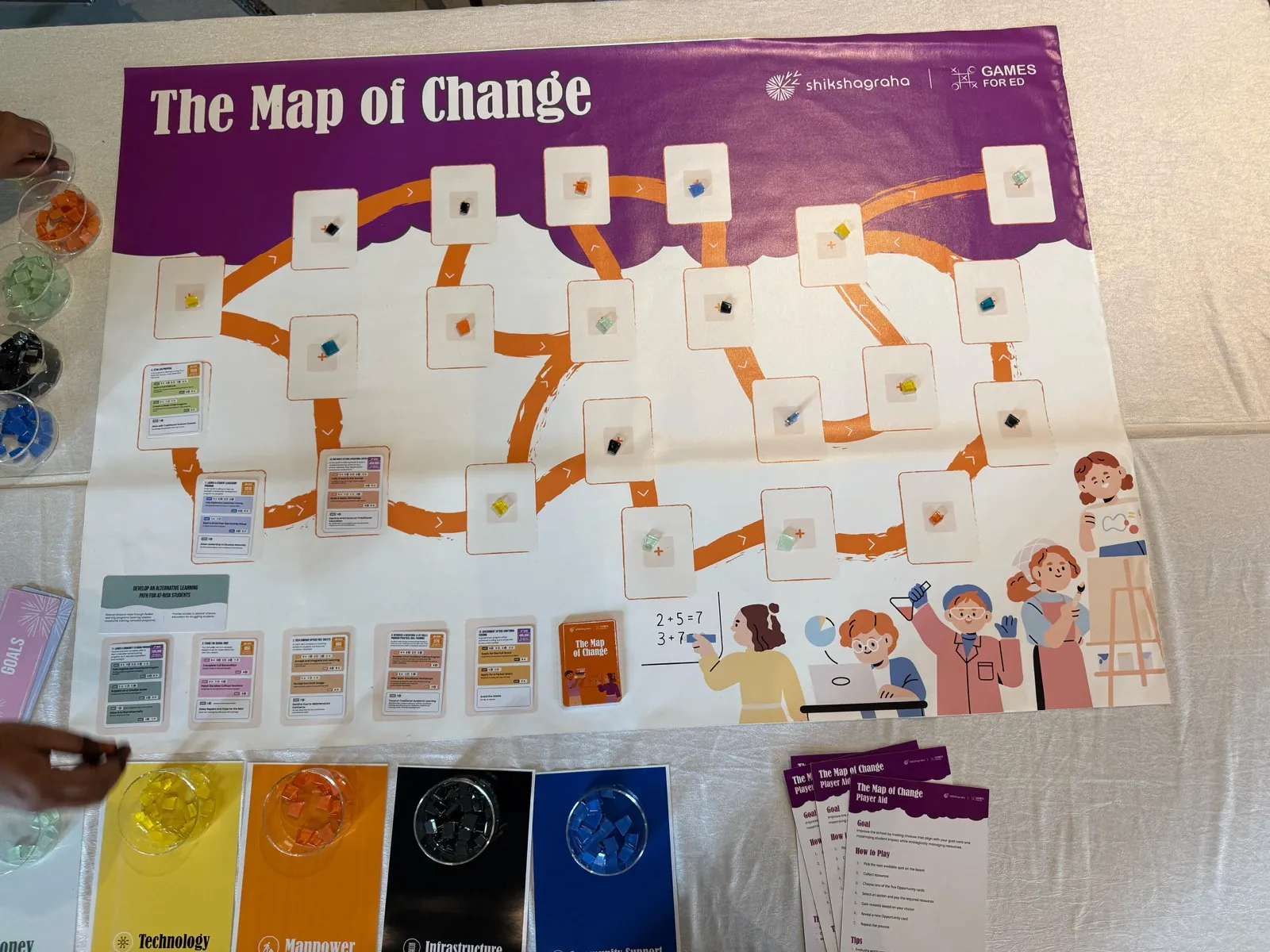
Every game I run is either built for the client's specific problem, or picked from my six proprietary games because it maps onto the outcome they need. There is no catalogue to browse. Before I design or choose anything, I want to know which leadership behaviour you are trying to grow, and why it is not showing up on its own... because that second half is usually the interesting bit.
Then the design answers that brief. If the problem is cross-functional collaboration falling apart, the simulation is built to make it fall apart, early, where everyone can see it and nobody gets hurt. If the problem is leaders defaulting to compliance instead of initiative, I build in the exact decision points where that instinct will show itself, and then I wait.
What participants get is something that feels like their Tuesday, not like an exercise lifted from a catalogue and delivered by a stranger who learned their names that morning.
The facilitation difference
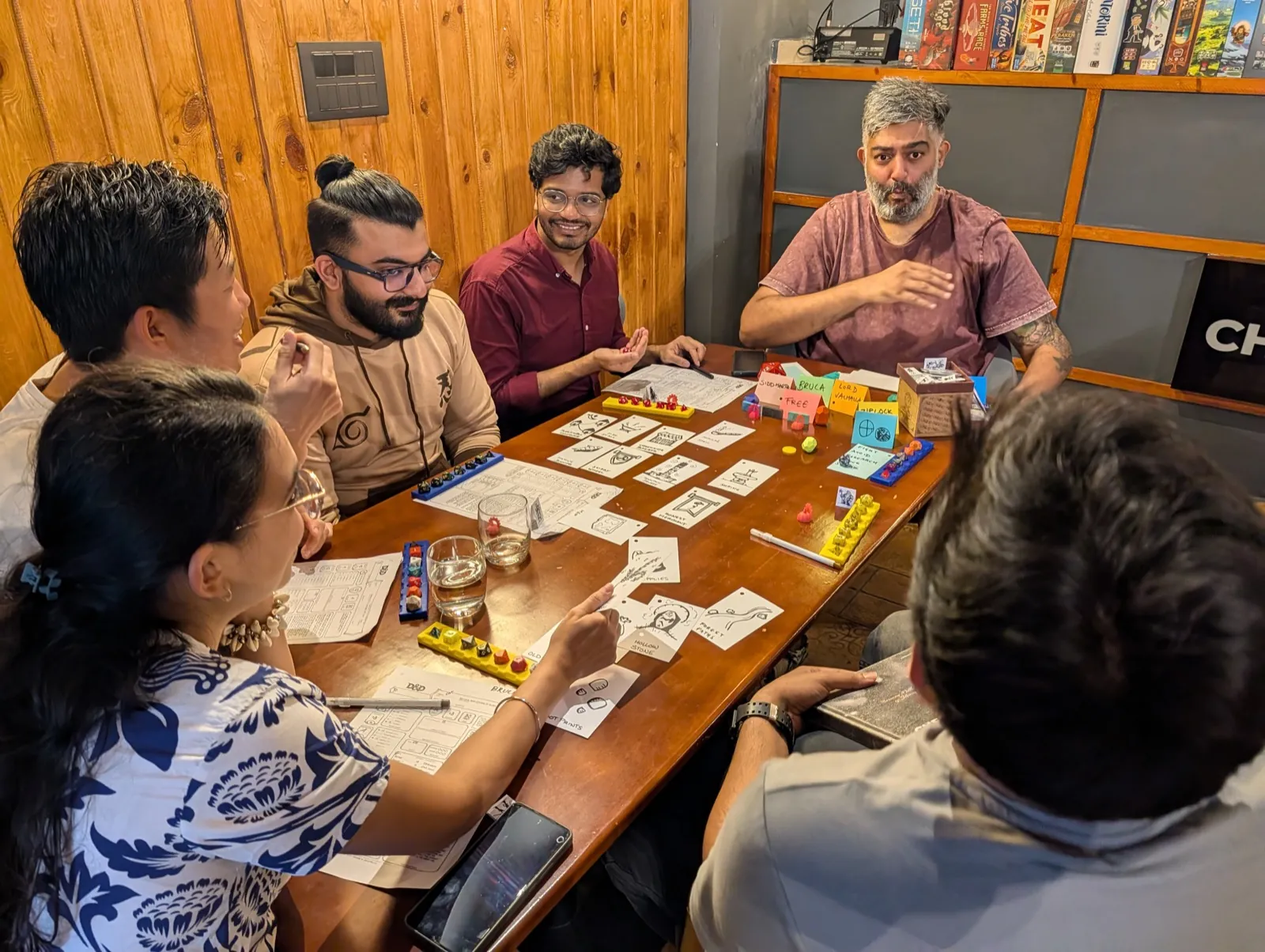
I design every game I use and I run every session myself. That is not a marketing line, it is the mechanical reason the debrief works. When the game ends, I am not asking anybody to imagine how they might behave in a real situation. I am asking about the thing I just watched them do. Specific moment. Specific call. Specific face.
I saw who went quiet when the stakes climbed. I saw which leader took the wheel when the group stalled, and whether that rescued the team or quietly shut three people up. I saw the exact round where the strategy changed and I know why. All of that is the debrief. None of it is on a card.
Generic debriefs produce generic reflection - everyone nods, nobody moves. A specific one makes somebody recognise themselves, and recognition is the only thing I have ever seen change behaviour past Tuesday.
 The bottom line
Off-the-shelf is a perfectly sensible buy when you need consistency across cohorts and the budget is the budget. I would recommend it to some of the people who write to me, and I have.
It is the wrong buy when you already know which behaviour is costing you money and you need that specific thing to shift. Then you want a simulation built around it, run by somebody who is in the room the whole time, reading what actually happens. That is what I do, and it is the only thing I do.
Common Questions
How do you know if a game fits our context?
Twenty minutes on a call. Tell me about the group, their level, and the behaviour you want to move. I will tell you which game fits - or that none of mine do, which happens, and I would rather say it than sell you a bad afternoon. That call is free.
Can we see the game before committing?
I will walk you through the mechanics and the debrief structure in as much detail as you want. What I cannot do is demo it, because a serious game with four polite people in a Zoom room produces nothing worth watching. It needs a live group to mean anything. Most buyers find the detailed brief is plenty.
How much longer does it take to get a custom or bespoke session compared to off-the-shelf?
One of the six existing games can be in your room 2-4 weeks after the first briefing call. A custom build takes 6-8 weeks, minimum, and I will not pretend otherwise to win the work. Honestly, most of the time one of the existing games fits well enough that building a new one would just be me showing off.

Related reading
- Serious games for leadership development: the complete guide
- Custom serious game design for your context
- Serious games vs gamification for leadership development
Frequently asked questions
Are custom serious games worth it vs off-the-shelf training?
Depends what you are buying it for. Off-the-shelf is worth it when you need the same programme to run identically in six cities and the budget is what it is. Custom is worth it when you want the behaviour to actually change, because the simulation is built around your particular problem and run by the person who watched it happen. One gives you a reliable session. The other gives you an uncomfortable one, which is the useful kind.
When is off-the-shelf training enough?
When you need the same thing everywhere with as little variation as possible, when budget or in-house expertise is tight, and when predictability genuinely matters more than fit. The content has been validated, the facilitator guide is written, the logistics are already solved. That is not nothing. If that is your actual problem, buy the box and get on with it.
How long does a custom serious game take to build?
One of the six games I already own can be in your room 2 to 4 weeks after the first briefing call. A fully custom build takes 6 to 8 weeks, minimum, and I will not pretend otherwise to win the work. Honestly, most of the time one of the existing games fits well enough that building a new one would just be me showing off.
With love from Bengaluru, this is Arvindh saying over and out.