
Breaking Down Silos: A Leader's Guide to Cross-Functional Collaboration
Silos are not an attitude problem. They are an incentive problem wearing an attitude costume.
The short version: silos are not caused by difficult people refusing to play nice. They are caused by clever people doing exactly what you pay them to do. Each function has its own scorecard, so each function protects its own scorecard. That is not a culture failure. That is the machine working as designed.
So you break them down by changing what people are accountable for. One shared goal. At least one shared metric. Dependencies out where everyone can see them. Not by telling everyone to "communicate more" and hanging a poster about it. Let me show you why, and what I have actually watched work.

Key takeaways
| The question | The honest answer |
|---|---|
| Why do silos form? | Each function is given its own goals, budget, and metrics, so it optimises its own scorecard. |
| Why is that a problem? | The sum of locally optimal decisions is almost never globally optimal for the company. |
| Whose job is it to fix? | Leadership. You cannot delegate breaking silos to the people the silos reward. |
| What actually works? | Shared goals plus shared metrics plus visible interdependence. Incentives before posters. |
| What does not work? | Rapport-building alone. It is pleasant and it fades, because the incentives are untouched. |
What "breaking down silos" actually means
A silo is a function that has quietly turned into a closed box. Own goals. Own budget. Own tools. Own private definition of a good quarter. Information goes in, decisions come out, and the rest of the company only ever sees the outside of the box. Breaking the silo down means wiring those boxes back together, so a decision made inside one has to answer for what it does to the others.
And here's what it is not. It is not getting departments to like each other more. Two heads of function can be genuinely fond of each other, share a chai every morning, and still quietly wreck each other's quarter... because affection does not change what you are paid to deliver. Cross-functional collaboration is a structural outcome, not a mood. Better catering at the offsite will not get you there.
 Why silos form - the part most leaders skip
Companies split into functions for a very good reason. Specialisation works. Sales should be brilliant at selling, operations at delivering, finance at money. So you give each one its own objectives and a number that tells you whether it is doing the job.
Perfectly sensible. Also the exact moment the silo is born.
Because the second a function has its own number, the people inside it do the only rational thing available. They chase that number. Now add a budget they have to defend, a reporting line they answer to, and a set of tools that will never speak to anybody else's tools. You have built a silo factory as a byproduct of doing everything else correctly.
The people are not the problem. The wiring is.
Which is why most silo-busting goes straight at the wrong target. A workshop on collaboration. A values poster in the lift lobby. A gentle request that everyone be more open. Then everyone walks back to a desk where they are still measured, paid and promoted on the local number. Nothing moves. Leadership concludes there is a culture problem.
There is no culture problem. Incentives beat intentions. Every single time.
Local optimisation vs global optimisation
Here is the engine under every silo. Local optimisation is each function maxing out its own number. Global optimisation is the whole company maxing out the thing that actually matters. And the brutal fact, well known to anyone who has ever done systems thinking, is that the sum of locally perfect decisions is almost never globally good.
Watch it happen. Sales is paid on bookings, so it closes everything it can touch, including the horribly customised ones. Operations is paid on utilisation and on-time delivery, so those custom deals blow up the schedule and ops digs its heels in. Finance is paid on margin, so it kills the discount that would have made the whole thing viable in the first place.
Everybody hit their target. Everybody behaved correctly. The customer got their thing late, the company made almost nothing on it, and nobody can be blamed. Three green dashboards and one lost quarter.
That is the signature of a silo. The cost is completely real and completely invisible, because it lives in the gaps between functions and no scorecard on earth measures a gap. Which is also why you cannot fix this from inside a function. The information you need to even see the problem only exists one level up. So breaking silos is a leadership job. Structurally. There is nobody else who can.
Why each function optimising its own scorecard hurts the whole
Three things happen, and all three cost you money:
- Trade-offs don't vanish. They land on whoever is weakest in the room. Not on whoever should carry them. On whoever cannot push back.
- Hoarding becomes the smart move. If passing on a forecast or a heads-up helps somebody else's number and does nothing for yours, sitting on it is simply correct. Do that across eight functions and the whole company stops telling itself the truth.
- The handoffs rot, because they belong to nobody. The seam where one team's output becomes another team's input has no owner and no metric. So quality, speed and trust all leak out at exactly that joint. Every time.
And here is the trap underneath the trap. The skill that got someone their seat is usually the skill of winning locally. You were made head of operations because you were relentless about operations. Now that same instinct is the one quietly sinking the company.
Nobody is being malicious. It is a real competence, aimed one level too low.
 How to break down silos - the sequence that actually holds
This is a sequence, and the order is the whole game. Change the incentives and the behaviour follows on its own. Do it the other way round and you get a lovely afternoon that has evaporated by Tuesday. So here is the order:
- Set one shared goal the whole leadership team owns - not five functional goals stapled together. One outcome no single function can deliver alone and all of them are accountable for. The test: if a department head can hit their personal targets while the shared goal fails, you do not actually have a shared goal.
- Build at least one metric every function holds in common - the cheapest silo-breaker there is. Give them a number they share, so a win for one cannot be a quiet loss for another without it showing up on both scorecards. It changes the daily maths of every decision.
- Make the interdependence visible, and watch the bad behaviour become socially impossible. Map where each function's decisions land on the others. People hoard and dump costs because the downstream effect is invisible to them - put that dependency on a wall and a lot of it simply stops.
- Model the trade-off in public, because silos are fractal. When you, the leader, openly take a hit to one function to win for the whole, you license everyone below to do the same. Protect your own turf and every layer beneath will copy you exactly.
- Reward the global win out loud - it beats a hundred teamwork posters. Promote and praise the manager who gave up a local point to win the company a goal, visibly. One real example teaches more than any values deck ever will.
 Incentives and shared goals: the one lever that actually moves it
If you take one thing from this page, take this. You cannot ask people to collaborate against their own incentives and expect it to survive a hard quarter. Goodwill is real. Goodwill is also a very small budget, and it runs out in March.
So make collaborating the locally smart move rather than the noble sacrifice. In practice: audit what each function is genuinely measured and paid on, find where those numbers shove against each other, then either add a shared one on top or rebalance the local ones.
Deeply unglamorous. Also the entire job. A leadership team that does this and skips the workshop beats a leadership team that does the workshop and skips this. Every time.
Why silos only become visible under real interdependence
Now the awkward bit. Put every leader in a meeting and ask them about silos, and all of them will agree that silos are bad and collaboration is good. Obviously. Nobody has ever announced that they intend to protect their turf at the company's expense.
Silo behaviour is not chosen. It happens automatically, under pressure, when your own number is on the line. You will never catch it in a discussion, because a discussion costs nothing. It only shows up when leaders are genuinely tangled together, when one person's win is visibly somebody else's loss, and the clock is running.
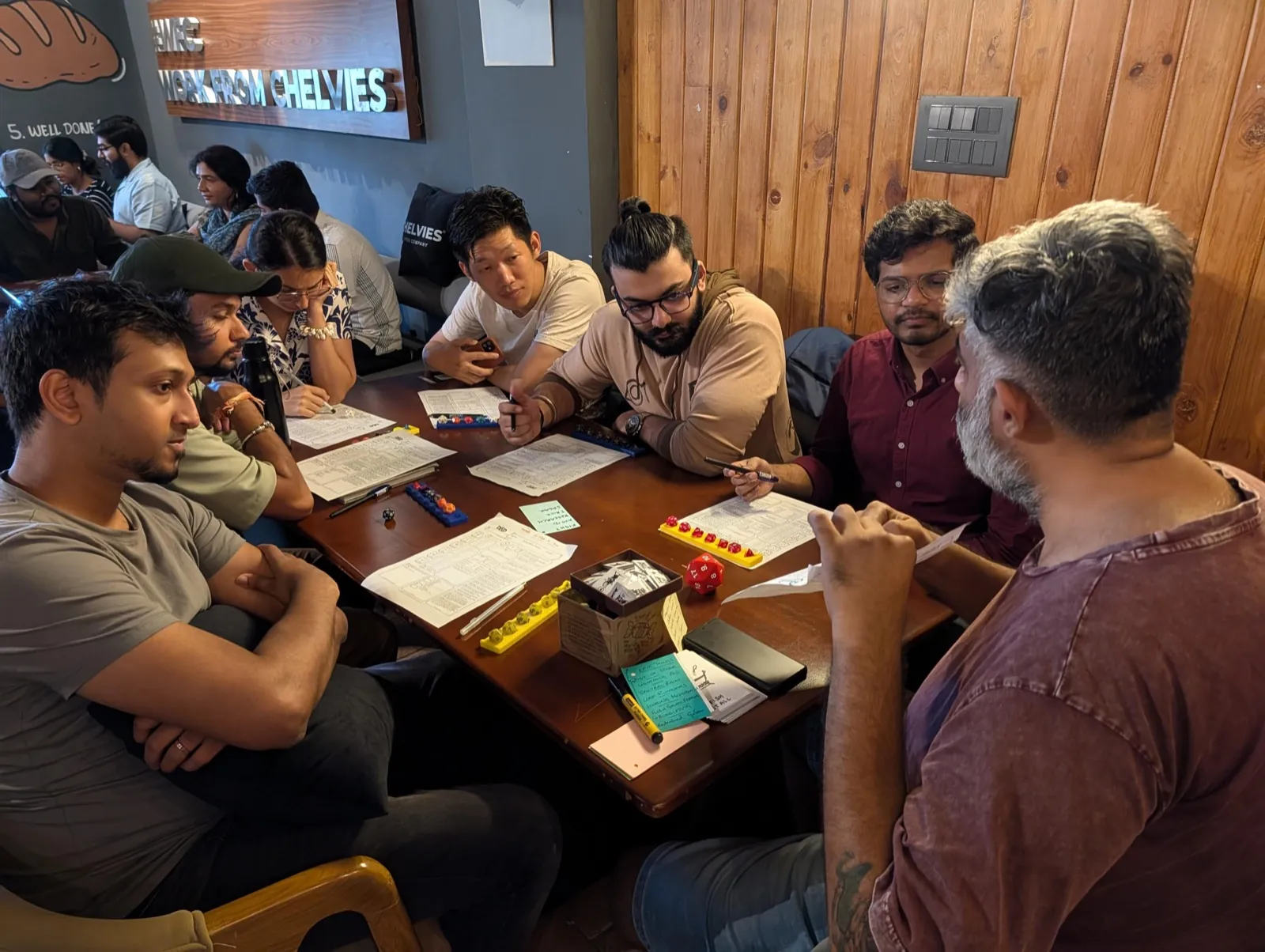
That is the whole idea behind Put The Player First. I don't lecture anyone about local versus global optimisation. I build a situation where they do it to themselves, watch the company lose while every scoreboard in the room stays green, and feel it. Then the debrief walks it back to their actual desks.
Insight you arrived at by losing is the kind that survives contact with Monday.
Watch silo behaviour happen in a room: Ripple Effect
Ripple Effect puts five people in the CXO seats of one company and gives them a finite pile of projects to fight over. Everyone protects their own function, exactly as they would on a Tuesday. Then the company sinks with all five scoreboards looking healthy. Three hours to arrive at a realisation that normally takes three years and one very bad annual review.
Get my facilitation playbooks and game notes by email
One short email whenever I have something you can actually use. A new game, a debrief move that worked, or an honest look at what happened in a real room last week. No schedule, no filler.

Straight answers
Basics
What does breaking down silos mean?
Taking out the structural and incentive walls that stop departments sharing what they know, so the company wins instead of five departments winning separately. A silo is just a function chasing the number it is paid on. You break it by changing accountability, not attitude.
Why do organisational silos form?
Because you split the company into functions, gave each one its own goals and metrics, and people did the sensible thing. Add separate budgets, reporting lines and tools and each function becomes a closed box with a private definition of winning. Predictable output of the structure. Nobody's character flaw.
The mechanics
What is the difference between local and global optimisation?
Local is each function maxing its own number. Global is the company maxing the thing that matters. The trap is that the sum of locally perfect decisions is almost never globally good. Everyone can show green while the company misses, because the cost lives in the gaps and no scorecard measures a gap.
Why does optimising each function hurt the whole?
Trade-offs land on whoever cannot push back. Hoarding information becomes the smart play. And the handoffs between functions belong to nobody, so they rot. The instinct to win locally is usually the exact skill that got the leader promoted, now aimed one level too low.
Fixing it
How do leaders break down silos?
Incentives first, behaviour follows. One shared goal the whole leadership team owns. At least one metric every function holds. Dependencies up on a wall where everyone can see them. Then take a public hit to your own function to win for the whole, and praise the person who does the same. Workshops only help if what people are measured on changes when they get back to their desks.
Can team building activities fix silos?
Rapport takes the edge off and then fades, because the incentives never moved. What shifts silo behaviour is an experience that makes leaders feel the cost of protecting their own corner, followed by a real change to shared goals and metrics. Connection without changed incentives is just a friendlier silo.
Related reading
- Serious games for leadership development: the complete guide
- Ripple Effect: the local-vs-global optimisation simulation
- The Put The Player First framework
See Ripple Effect Talk to me about a session
With love from Bengaluru, this is Arvindh saying over and out.