Case Studies › Frontline Manager Program
Stakeholder Management, Played Not Lectured
13 front line managers at a leading HR-tech platform, one day, two physical games. Not a single slide about influence.
The Challenge
Managing stakeholders is the job. Nobody trains for it.
Nobody hands a new manager the map. On day one they inherit a tangle of competing priorities, strong personalities and quiet power lines, and then they work it out by getting it wrong for a year.
The brief from the client was refreshingly blunt. Build something that works on Monday morning, not something that makes sense in a classroom.
Which rules out the lecture. Rules out frameworks on slides. What is left is an experience where the learning happens inside the doing, with something at stake and the consequences visible to everyone in the room within the hour.
The Approach
Two physical experiences. Zero passive learning.
One day. Two games you play with your hands. And a debrief that tied every move back to a real person these managers were already dreading a conversation with.
Activity 01
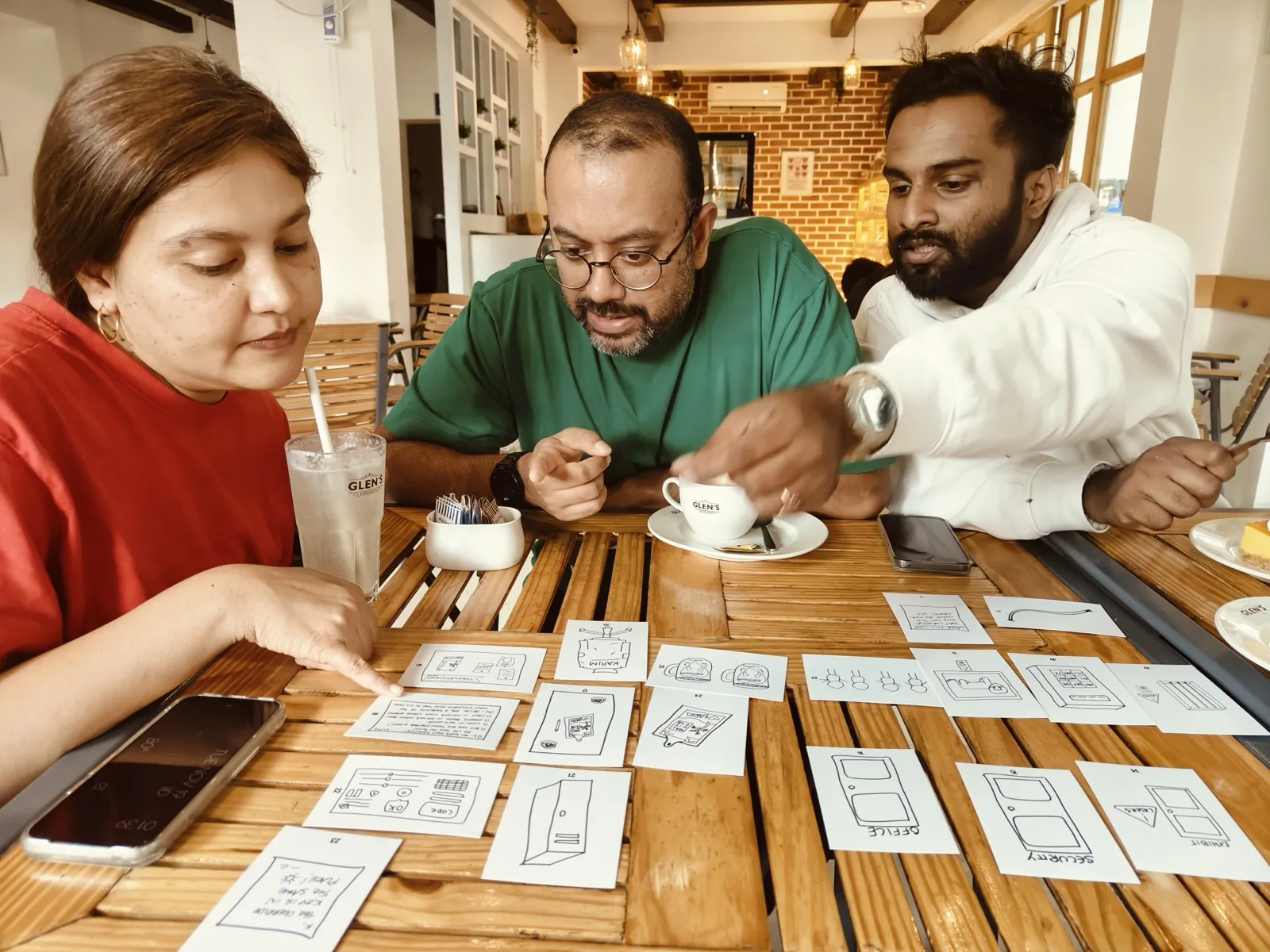
Bloom
A garden you have to keep alive across eight rounds. Every plant is a stakeholder with its own needs, its own timeline, its own idea of what a good outcome looks like. You get five actions a round. Which means somebody's plant does not get watered this week.
That is the whole game. And the moment somebody realises they have been lovingly over-tending the easy plant while the important one quietly dies... that is the moment the day starts working.
- PlantsStakeholders. Different needs, timelines, conditions for success.
- 5 actions/roundFinite attention. You can't tend everyone equally.
- HazardsConflicts and blockers. Ignore them and the relationship stops producing.
- PruningManaging expectations. Cutting back is what makes something grow.
- The gardenThe whole map. One plant always affects the others.
Activity 02
Lego Stakeholder Map
Each manager builds their actual stakeholder world in bricks. Every piece is a person, a relationship or a dependency. And you cannot be vague with Lego. Either the brick is there or it isn't.
Then they present the thing and take questions from their peers. Gaps show up. Bottlenecks show up. So do a few dependencies nobody had ever said out loud, sitting right there on the table where everyone can see them.
Frameworks
The thinking tools behind the play.
Five frameworks held the debrief together. Every one of them arrived after the thing it explains had already happened to somebody in the room. That is the order that makes a framework stick.
- 01
FIDO MOST CITED
Stakeholder classification and response.
- 02
Power-Interest-Impact Grid
Prioritising where to invest your attention.
- 03
Employee Archetypes
Reading the room, adapting by personality.
- 04
Conflict Management
Structured approaches to stakeholder friction.
- 05
Relationship Mapping
Visualising dependencies and influence lines.
Results
Zero negative responses. Across every measure.
Understood the learning objectives
Will apply to their current role (zero disagree)
Learning enriched by facilitator examples
Had plenty of opportunity to ask questions
What Stuck
In their words.
"FIDO"
Most cited framework, in participant feedback
"The garden metaphor"
Recurring theme across participant responses
"Prioritising stakeholders"
Named by multiple participants as key takeaway
"Conflict management"
Named by multiple participants as key takeaway
Want to run this for your managers?
Bloom runs on its own, or as part of a full frontline manager programme. I designed it, I run it, nobody else touches it. Come and see.
Get the next case study by email
One short email when there is a new game, a debrief move that worked, or a real session written up honestly. Nothing else, ever.
With love from Bengaluru, this is Arvindh saying over and out.